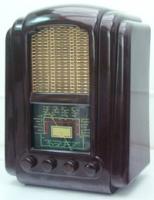
Laurie, just to help you on your way it is useful to know the basic outline of a receiver such as the one you have.
In simple terms with your receiver the signal (radio broadcast) is picked up by the RF (radio frequency) coil (inductor) on the ferrite rod, that RF coil is tuned to the frequency you want to receive by the RF tuning capacitor, that capacitor is ganged (shares a common shaft) with the Oscillator tuning capacitor (more about that in a minute) by connecting the coil and capacitor in parallel we have a tuned circuit, if the inductor and capacitor are of a fixed value then the frequency it is tuned to will be fixed but if the inductor or capacitance value can be made variable then we can now tune the tuned circuit to different frequencies ie: one end of the MW band to the other end, it is more practical to have a fixed inductor value and vary the capacitance value.
So far so good, now we can tune in the RF signal but it's still very weak and it needs to be amplified and it's modulation detected to be of any use, the signal has been selected but the selectivity needs to be better also.
So what's next, well we can convert the signal to a lower frequency as in general lower frequency signals are easier to amplify, it is also easier to get better selectivity by passing a lower frequency signal through a parallel tuned circuit, this lower frequency signal is called the Intermediate Frequency aka IF frequency, that frequency will be between our original RF frequency (the one we have already tuned in) and Audio frequency aka AF.
So how do we change the RF to the now required IF?
This is done in what is referred to as the Mixer, aka Frequency Changer.
Without getting to tech, if we feed the RF signal into a non linear device such as transistor or a valve along with an Oscillator signal of a higher frequency then we will have four main frequencies coming out of that device, one will be the original RF signal frequency let's call that Fs, another will be the Oscillator frequency let's call that Fo, another will be Fo + Fs (the sum) The other will be Fo - Fs (the difference) It's the latter one we are interested in, it's this difference frequency that we call the IF frequency, so say for instance we want the IF frequency to be 470Khz (for easier amplification) and the RF signal frequency to the input of the Mixer is say 1.5 Mhz then the Oscillator frequency needs to be 1.5 Mhz + 470 Khz which gives us 1.970 Mhz, the difference frequency after mixing being 1.970 (Fo) - 1.5Mhz (Fs) which is the 470Khz IF frequency we want, this frequency is tuned by the 1st IF transformer which acts as the mixer device load, this will pass the now required IF frequency and reject the other frequencies generated by the mixer ie: Fo, Fs, Fo + Fs etc.
This IF frequency then goes through one or two stages of amplification and tuning to improve the selectivity and to increase the signal level suitable for detection of the audio modulation. The audio stages are fairly self explanatory.
Lawrence. [EDIT: Forgot to add: Ideally the Oscillator frequency (Fo) should equal the Signal frequency (Fs) + the IF frequency (Fi) across the whole tuning range, this is called tracking but in practice it's almost impossible to do so accurately across the whole band, instead the Oscillator and RF alignment is usually adjusted exactly at only two points on the tuning dial/scale, one alignment point is set towards the bottom end of the wave band selected and the other towards the top end, this is normally referred to as two point tracking.]
In simple terms with your receiver the signal (radio broadcast) is picked up by the RF (radio frequency) coil (inductor) on the ferrite rod, that RF coil is tuned to the frequency you want to receive by the RF tuning capacitor, that capacitor is ganged (shares a common shaft) with the Oscillator tuning capacitor (more about that in a minute) by connecting the coil and capacitor in parallel we have a tuned circuit, if the inductor and capacitor are of a fixed value then the frequency it is tuned to will be fixed but if the inductor or capacitance value can be made variable then we can now tune the tuned circuit to different frequencies ie: one end of the MW band to the other end, it is more practical to have a fixed inductor value and vary the capacitance value.
So far so good, now we can tune in the RF signal but it's still very weak and it needs to be amplified and it's modulation detected to be of any use, the signal has been selected but the selectivity needs to be better also.
So what's next, well we can convert the signal to a lower frequency as in general lower frequency signals are easier to amplify, it is also easier to get better selectivity by passing a lower frequency signal through a parallel tuned circuit, this lower frequency signal is called the Intermediate Frequency aka IF frequency, that frequency will be between our original RF frequency (the one we have already tuned in) and Audio frequency aka AF.
So how do we change the RF to the now required IF?
This is done in what is referred to as the Mixer, aka Frequency Changer.
Without getting to tech, if we feed the RF signal into a non linear device such as transistor or a valve along with an Oscillator signal of a higher frequency then we will have four main frequencies coming out of that device, one will be the original RF signal frequency let's call that Fs, another will be the Oscillator frequency let's call that Fo, another will be Fo + Fs (the sum) The other will be Fo - Fs (the difference) It's the latter one we are interested in, it's this difference frequency that we call the IF frequency, so say for instance we want the IF frequency to be 470Khz (for easier amplification) and the RF signal frequency to the input of the Mixer is say 1.5 Mhz then the Oscillator frequency needs to be 1.5 Mhz + 470 Khz which gives us 1.970 Mhz, the difference frequency after mixing being 1.970 (Fo) - 1.5Mhz (Fs) which is the 470Khz IF frequency we want, this frequency is tuned by the 1st IF transformer which acts as the mixer device load, this will pass the now required IF frequency and reject the other frequencies generated by the mixer ie: Fo, Fs, Fo + Fs etc.
This IF frequency then goes through one or two stages of amplification and tuning to improve the selectivity and to increase the signal level suitable for detection of the audio modulation. The audio stages are fairly self explanatory.
Lawrence. [EDIT: Forgot to add: Ideally the Oscillator frequency (Fo) should equal the Signal frequency (Fs) + the IF frequency (Fi) across the whole tuning range, this is called tracking but in practice it's almost impossible to do so accurately across the whole band, instead the Oscillator and RF alignment is usually adjusted exactly at only two points on the tuning dial/scale, one alignment point is set towards the bottom end of the wave band selected and the other towards the top end, this is normally referred to as two point tracking.]